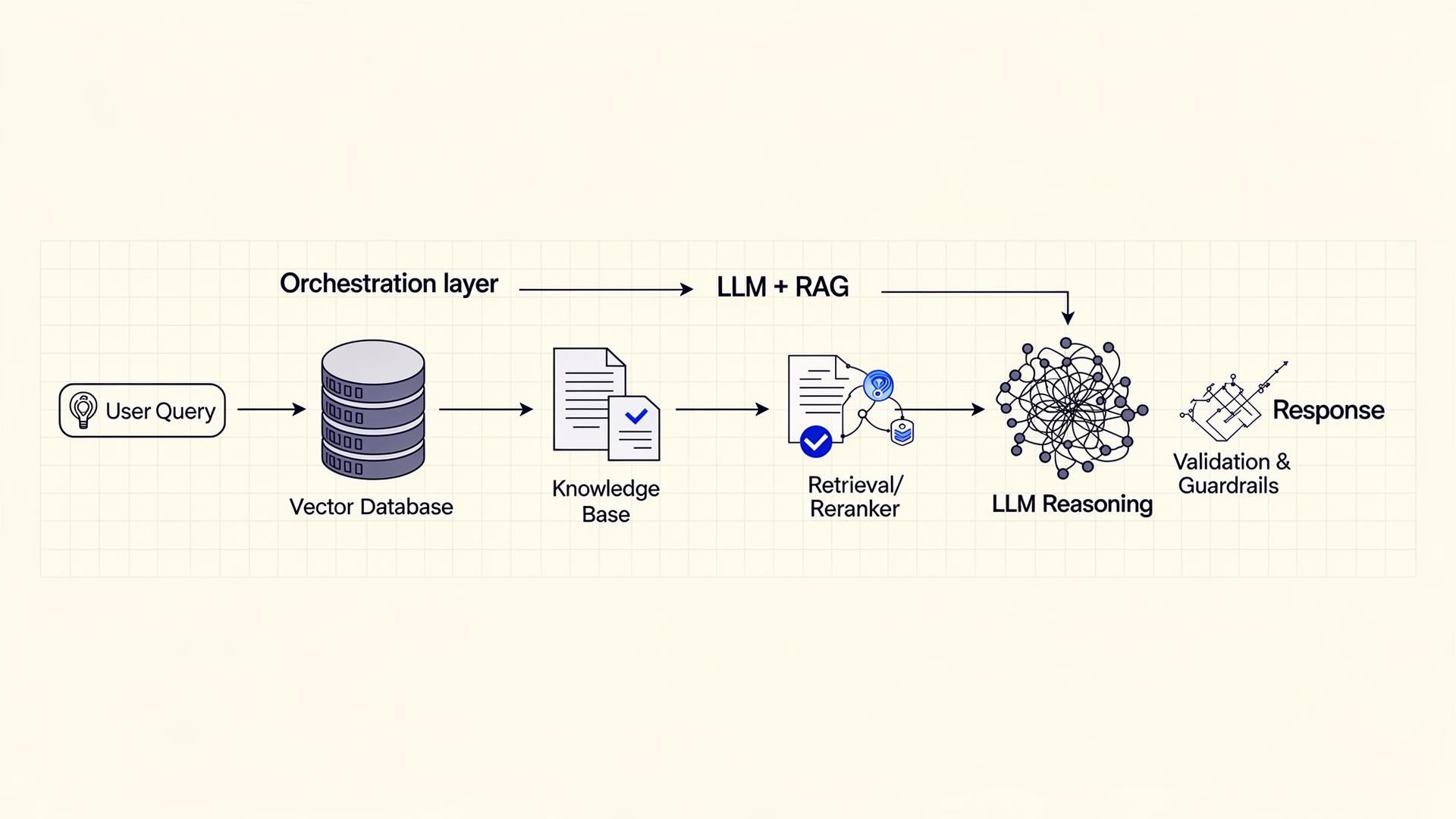
 AI Architecture
The Reference Architecture for LLM + RAG Systems That Survive Production
Most LLM applications fail in production not because of model limitations, but because of weak system architecture. When an LLM is wired directly to raw data without orchestration, retrieval, and validation layers, the system becomes unreliable, inconsistent, and difficult to scale.
A production-grade AI system is not an LLM integration. It is a structured architecture where retrieval, reasoning, and validation are clearly separated.
This article is the reference architecture I deploy for clients building internal AI assistants, document intelligence platforms, and enterprise knowledge systems.
The Problem
A naive LLM application looks like this: user prompt → LLM → response. It works on the first ten queries. It fails on the next ten thousand because:
- The model has no grounded source of truth
- Outputs are unstructured and unverifiable
- One bad prompt path can take down the entire service
- There is no boundary between user input, internal logic, and model authority
Why Typical Implementations Fail
Single-layer systems collapse under three forces: scale, ambiguity, and accountability. You cannot tell a regulator that "the LLM decided." You cannot debug a system where retrieval, reasoning, and formatting all happen inside one prompt. And you cannot scale a system whose cost is unbounded.
The Reference Architecture
The fix is to design the system as a multi-layer pipeline where each layer has a single, testable responsibility.
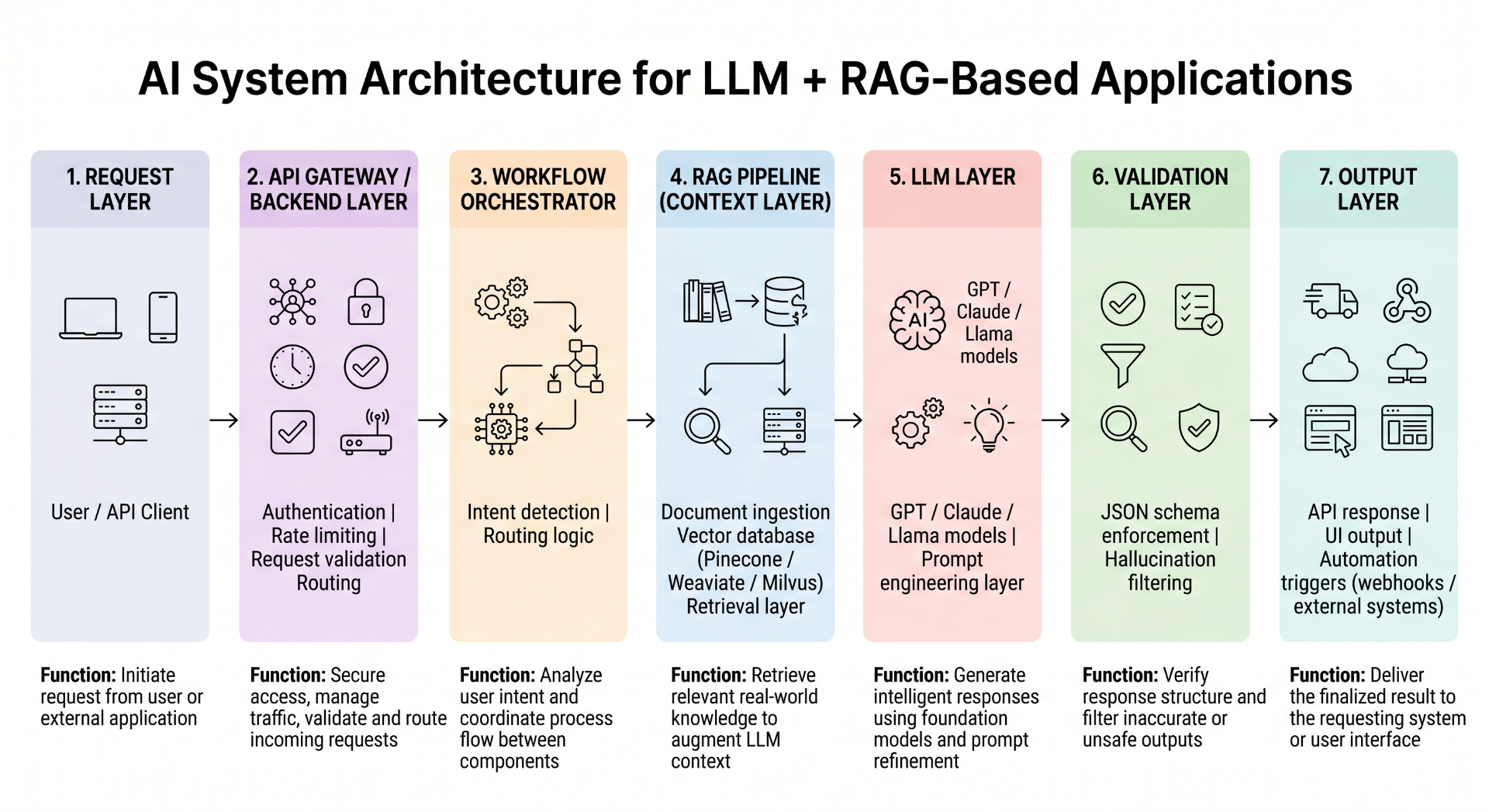
1. Request Layer
The entry boundary. Nothing downstream trusts input that has not passed through it.
2. API Gateway
Operational concerns that protect the rest of the system: authentication, rate limiting, request validation, secure routing. Without this layer, every downstream component re-implements the same defenses.
3. Workflow Orchestrator
Controls execution flow — in code, not in an LLM decision. Detects intent, selects the pipeline, coordinates downstream components. The LLM chooses tools; the orchestrator chooses the graph.
4. RAG Pipeline
Grounds the model in relevant information: ingestion, chunking, embeddings, vector storage (Pinecone, Weaviate, Milvus), hybrid retrieval, reranking. The LLM never operates on raw inputs — only on retrieved, scoped, validated context.
5. LLM Layer
Reasoning and generation. Prompt engineering enforces consistent, structured instructions. Outputs are constrained to schemas.
6. Validation Layer
Where production safety is won: schema enforcement, output structure checks, hallucination filtering against retrieved context. Reject early, retry deterministically, escalate when needed.
7. Output Layer
API responses, UI surfaces, downstream webhooks — every output carries provenance metadata (which retrieval, which prompt, which validator passed it).
Deploying This Pipeline on Cloud Infrastructure
The reference architecture above is platform-agnostic, but in enterprise engagements we ship it on a specific cloud footprint. The recommended deployment shape:
- Compute: containerized services on AWS ECS with Fargate (or GKE Autopilot / Azure Container Apps). Each layer — gateway, orchestrator, retrieval, LLM proxy, validator — runs as an independent service with its own autoscaling profile. Fargate eliminates node management and makes per-request cost attribution clean.
- Vector store: managed Pinecone, OpenSearch Serverless (k-NN), or pgvector on Aurora Serverless v2. The choice is driven by hybrid-search requirements and existing data-residency commitments, not benchmark headlines.
- Identity & access: enterprise IAM-driven metadata filtering at retrieval time. The user's identity (via Cognito, Entra ID, or Okta) is exchanged for short-lived AWS STS credentials, and those credentials carry session tags (department, clearance, region) that the retriever pushes directly into the vector query as metadata filters. Permissions are enforced before results enter the LLM context window — never after.
- Secrets & keys: AWS Secrets Manager / Parameter Store for model API keys; KMS-encrypted envelopes for tenant-specific embeddings.
- Observability: OpenTelemetry traces to CloudWatch + a managed tracing backend (LangSmith, Langfuse, or Datadog). Every request carries a correlation ID through all seven layers.
- Deployment: blue/green via ECS deployment circuit breakers; eval-gated promotion — a build only reaches production if the golden-set harness passes.
This is the same footprint that powers the production systems referenced in the case studies. It is boring on purpose — boring infrastructure is what lets the AI layer be interesting.
Tradeoffs and Design Decisions
- Latency vs. reliability. Each layer adds milliseconds. Each layer also removes a class of silent failure. Default to reliability.
- Build vs. buy retrieval. Managed vector DBs are faster to start with; self-hosted gives you control over hybrid search and reranking.
- Strictness of validation. Strict schemas reject more outputs and force better prompts. Loose schemas ship faster and leak hallucinations.
Expected Outcomes
When the architecture is in place, the system becomes reliable in real-world use, easier to scale and maintain, less prone to hallucination, and adaptable across multiple AI use cases on the same backbone.
Key Takeaways
A production-grade AI system is structured architecture, not an integration. Retrieval, reasoning, and validation are separate concerns. That separation produces predictable behavior, better performance, and long-term scalability — and it is what lets you ship the second, third, and tenth use case on the same foundation.